This is an evolving program. Like any other trade such as medicine, architecture, manufacturing, etc., the discipline of Product is imperfect and will continually improve and become better. This Growth Program must do the same.
Overview
As a user of this growth program, how do I get started?
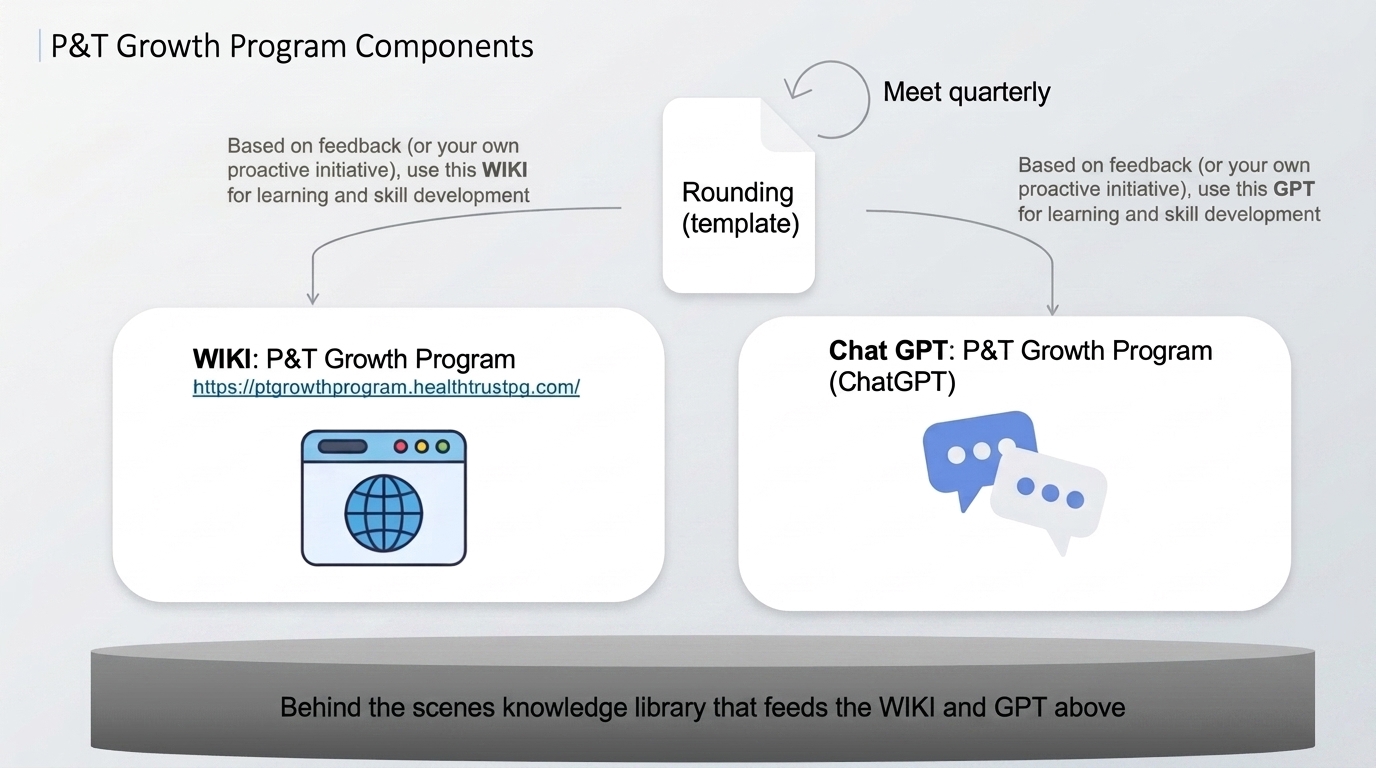
Helpful links from the graphic: Rounding Template WIKI GPT Coach
This growth program is a living document that will continually be updated going forward. It includes an "article canon" of helpful references to our own unique Technology Operating Model (TOM). Each article has a TLDR document, which includes 1) Cody's perspective, 2) an AI summary, and 3) the content dump from the article itself.
Our P&T orgs largely fall into these identities:
- Customer Solutions (Tommy): member / customer facing solutions
- Data Solutions (Joe): this is a hybrid. Data is an indirect value to the Membership (Customer) as well as Sourcing. When data is being curated for our members, Data Solutions needs to practice a lot of product dev principles.
- Sourcing Solutions (Scott): this is internal facing and the product dev practices need to be applied appropriately and more efficiently considering there is far less work to get consensus from internal stakeholders.
For shared continued growth, there is also a rounding template that will be used quarterly between the supervisor and the individual, focusing on technical leadership maturity and systems design thinking.
You can get to a published version here to share:
https://ptgrowthprogram.healthtrustpg.com/technology/index.html
I. Technology Operating Model: Article Canon
Each resource serves as a foundational pillar for the department’s collective mental model. Especially at a leadership level, while the tactics, architectures, and processes are important, the overall art of thinking of technology leadership and the mental model is most important. Getting lost in the academics or technicalities is a way to miss the mark entirely.
1. Get Stuff Done (Meta-TLDR)
Focuses on optimizing delivery velocity, quality, and DORA metrics. This ensures our technology teams are reducing friction and maintaining a high-value, efficient deployment engine.
- The SPACE of Developer Productivity (TLDR): A multidimensional framework for understanding developer productivity across satisfaction, performance, activity, communication, and efficiency.
- DevEx: What Actually Drives Productivity (TLDR): Focuses on developer experience as the primary driver of productivity, highlighting feedback loops, cognitive load, and flow state.
- Measuring Developer Productivity via Humans (TLDR): Argues for the value of qualitative, developer-centric feedback loops over telemetry logs for identifying system bottlenecks.
- Maximizing Developer Effectiveness (TLDR): Focuses on how organizations can improve productivity by optimizing day-to-day micro-feedback loops and developer workflow.
- DORA Key Metrics (TLDR): The industry-standard metrics (deployment frequency, lead time for changes, change failure rate, and time to restore service) to measure delivery speed and quality.
- How to Make Good Code Reviews Better (TLDR): Outlines how to elevate code reviews from basic correctness check-ins to high-throughput, empathetic feedback loops that leverage automation and optimize DevEx.
- INVEST (TLDR): A checklist of key criteria (Independent, Negotiable, Valuable, Estimatable, Small, Testable) to assess user story quality, optimizing backlog flow and sprint throughput.
- What is Agile Methodology (TLDR): An introductory overview of the iterative framework, outlining its 12 core principles and stage-by-stage lifecycle to support deployment velocity and team adaptability.
- The Agile Manifesto: The primary source: the four values and twelve principles of agile software development, from the manifesto's original authors, supporting deployment velocity and team adaptability.
- Software Estimations and Agile — Friends or Foes? (TLDR): Explores the tension between software estimations and Agile methodologies, showing how to balance predictability and adaptability by treating estimates as planning and decision-making tools rather than performance metrics or deadlines.
- **Stop Starting and Start Finishing** (TLDR): Awesome kanban principles about focus on getting units across the board and delivered. Work your "board" from right to left.
2. Technical Skills (Meta-TLDR)
Focuses on simple, maintainable software design (KISS/YAGNI) to eliminate over-engineering, and robust site reliability practices—including monitoring, backups, and incident response—to guarantee stable and resilient production environments.
- KISS Principle (TLDR): Optimize simplicity over scale. Discusses the criticality of keeping designs and systems as simple as possible to minimize bugs, lower cognitive load, and ensure long-term maintainability.
- YAGNI (TLDR): Explains the Extreme Programming (XP) principle of "You Aren't Gonna Need It," examining the four economic costs of building presumptive features and the necessity of malleable code.
- Choose Boring Technology (TLDR): The problem with “best tool for the job” thinking is that it takes a myopic view of the words “best” and “job.” Your job is keeping the company in business. And the “best” tool is the one that occupies the “least worst” position for as many of your problems as possible.
- Not Invented Here (TLDR): Don't reinvent the wheel. Explores the cultural and architectural antipattern of rejecting external solutions in favor of in-house development, emphasizing the costs of reinventing the wheel.
- Principle of Least Astonishment (TLDR): No surprises! Recommends that software and interface behaviors always align with the existing mental models of users and developers to prevent integration errors and minimize surprise side effects.
- Software Design: The Goldilocks Zone of Complexity (TLDR): Explores the tension between abstraction bloat (over-engineering) and spaghetti bloat (under-engineering), showing how to navigate the "Goldilocks Zone" of complexity through YAGNI, agile iteration, and continuous refactoring.
- Software Never Fails (TLDR): Argues that software never undergoes random failure but instead executes flawed designs, showing that reliability requires modeling systemic interactions rather than relying on component redundancy.
3. Security and Secure Software Development (Meta-TLDR)
Prioritizes embedding security practices and standards deeply into the entire development lifecycle, protecting the platform and our data from day one.
- OWASP Top 10: The industry-standard baseline of what actually goes wrong in production. Leadership takeaway: know the risk categories well enough to ask the right questions in design reviews.
- NIST Secure Software Development Framework (SSDF, SP 800-218): The standard reference for what a secure SDLC actually requires, useful for benchmarking internal practices and vendor/procurement conversations.
- Threat Modeling Manifesto: A lightweight, leadership-digestible framing of why and how teams should threat-model, without requiring deep technical mechanics.
- SLSA (Supply-chain Levels for Software Artifacts): Supply chain integrity framework, relevant given how much of any modern stack is third-party and open-source dependencies.
- OWASP SAMM (Software Assurance Maturity Model): A maturity-model lens for assessing how secure the org really is across people, process, and tech, similar in spirit to how DORA metrics are used for delivery.
- Reflections on Trusting Trust: Ken Thompson's 1983 ACM Turing Award lecture (published 1984). A classic, leadership-friendly parable on why you can never fully outsource trust in your toolchain, good for instilling healthy paranoia about supply chain and insider risk.
- HITRUST CSF overview: Directly relevant given the industry, leaders should understand at a conceptual level what compliance posture the org is held to and why it constrains architecture choices.
4. Developer Culture (Meta-TLDR)
Centers on fostering an environment of autonomy, psychological safety, and true mission-driven engineering, ensuring teams are motivated and supported to solve hard problems.
- One-way and Two-way Door Decisions (TLDR): Build in a way that minimizes the cost of being wrong. Explores a decision-making model categorized by reversibility, helping leaders delegate reversible choices to empower engineering teams and speed up delivery.
- The Law of Buy-In (TLDR): Followers prioritize finding a trusted leader before committing to a vision, making personal credibility the foundational prerequisite for empowering developer teams.
- The 10 Commandments of Egoless Programming (TLDR): Fosters collaborative, healthy engineering teams by separating developer ego from code, building psychological safety and objective peer review structures.
- Why Your 'Harmonious' Team Is Actually Failing (TLDR): Argues that conflict-avoidant 'nice' teams stifle critical thinking, explaining that true psychological safety requires productive technical friction to expose flaws before code hits production.
- It’s time to break free from Corporate Agile (TLDR): Rejects rigid, top-down Scrum processes in favor of bottom-up team autonomy, empowering developers to self-organize and handle complexity through supportive, low-overhead management.
- On Being A Senior Engineer (TLDR): Redefines seniority as a state of sociotechnical maturity characterized by egoless collaboration, explicit trade-off management, and active career sponsorship.
- Ownership (TLDR): Focus on owning the Problem and not just the Solution. Defines end-to-end ownership for developers on small teams, establishing a mental checklist (problem definition, edge cases, failures, data flow, manual testing, deployment, and communication) and outlining expectations for all developers.
- Nobody is coming to save your career (TLDR) A bit extreme, but the point is to take your growth into your own hands and be unstoppable and relentless. Use your manager as a resource.
- **Trust but Verify** and **Lesson One: Trust but Verify** (TLDR): Trust is paramount for having productive and empowered teams, but not inspecting consistently is irresponsible and not protecting the team
5. Communications (Meta-TLDR)
Focuses on establishing clear and effective communication loops upwards to leadership, laterally with product partners, and downwards within the engineering organization.
- Managing Your Boss: Gabarro & Kotter, HBR, 1980. The canonical piece on managing up as an active, deliberate discipline rather than something that just happens to you.
- Radical Candor: Kim Scott. Framework for balancing directness with care, useful for downward feedback and difficult conversations with reports.
- The Pyramid Principle: Barbara Minto. Structuring written and verbal communication so the conclusion leads instead of getting buried, directly applicable to exec updates and status reports.
- Crucial Conversations: Patterson, Grenny, McMillan, Switzler. A foundational book (linked to the publisher's overview) providing a standard framework for high-stakes, emotionally charged conversations: performance issues, conflicting priorities, escalations.
- Nonviolent Communication: Marshall Rosenberg. Underlying model for de-escalating lateral conflict between peer orgs, relevant given the Customer / Data / Sourcing Solutions split described in the program overview.
- Amazon's 2017 Letter to Shareholders: The "Six-Page Narratives" section. Bezos's own explanation of why Amazon replaced PowerPoint with narrative memos, a useful counterpoint for leaders who default to slides.
- Managers, Take Your 1:1 Meetings to the Next Level (TLDR): A masterclass in coaching conversations. It provides the specific "Question Banks" for Pillar 4 (Rounding), helping leaders move from status updates to uncovering deep organizational issues. Highly recommend Dossier - The Tactical Guide to Managing Up: 30 Tips read too.
6. Outcomes Alignment and Value Realization (Meta-TLDR)
Ensures technology leaders are intrinsically focused on producing measurable business value, evaluating their technical successes on actual outcomes rather than just shipping lines of code or outputs.
- Can Your Team Pass the Elevator Test? (TLDR): Emphasizes the disconnect between coding and problem-solving, urging teams to establish a clear project vision so every developer can explain what they are doing and why it matters in under 60 seconds.
- Gilb's Law (TLDR): Explores the principle that anything requiring quantification can be measured in a way that is better than not measuring it at all, preventing decision blindness.
- Assessing Product Opportunities (TLDR): Outlines Marty Cagan's ten-question Product Opportunity Assessment framework as a lightweight alternative to MRDs/PRDs to prevent wasting resources on poor ideas.
- Stop Separating Learning from Building (TLDR): Advocates for structuring engineering pilots around a central technical hypothesis, building production-grade software from day one to maximize validated learning and mitigate investment risk under uncertainty.
- Removing Uncertainty: The Tip of the Iceberg (TLDR): Redefines project progress as the reduction of uncertainty rather than task completion, using prototyping, API contracts, and shadow deployments to systematically de-risk execution and secure stakeholder trust.
- OKR and Agile (TLDR): Connecting high-level goals to daily execution without micromanagement.
II. Competency Matrix
The technology leveling matrix spans from individual contributor Developers up to the VP of Technology. This serves as a developmental rubric mapping core engineering maturity, systems design thinking, and operational capability.
III. Rounding and Coaching
Rounding Template: Structured 1:1 and departmental coaching template here. This document focuses conversations on systems design judgment, organizational health, and leadership maturity rather than tactical status reporting.
Protocol: Rounding is conducted quarterly for the leadership pipeline (VP, AVP, Director, and Manager). For the Manager-to-Developer relationship, rounding is conducted monthly to align growth directly with day-to-day execution.
Homework: Leaders must complete the Technology Leader Rounding Template asynchronously ahead of the session, referencing specific architectural tradeoffs and organizational artifacts to ground the conversation in objective reality.
IV. AI Support as a GPT
Technology Coach GPT: An agentic AI trained on the Article Canon and personal leadership principles. It provides just-in-time coaching and feedback for all topics in this technology development growth program.
Helpful prompt ideas to get you started, both for yourself as well as a manager.